
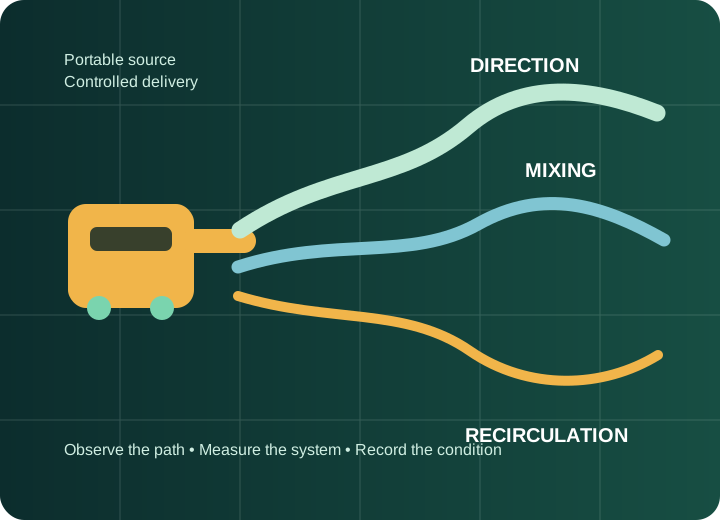
“Utility fogger” is a use category—not one universal machine
A utility fogger is a portable fog-generation tool used to make otherwise invisible airflow visible. The phrase can also refer to the historic Utility Fogger / UF2 product family, but this site focuses on the broader engineering use case.
The right system depends on the environment, required fog purity, output, runtime, delivery geometry, control method and whether water, cryogens or chemical aerosols are acceptable.
One tool category, several different jobs
Building and HVAC diagnostics
Visualize diffuser throw, supply-to-return short-circuiting, recirculation, door pathways and room mixing before quantitative TAB work.
Laboratory ventilation
Observe cross-drafts, exhaust capture tendencies, enclosure interactions and operator/equipment effects under a controlled test plan.
Equipment cooling
Trace intake, exhaust and recirculation paths around electronics, racks, process enclosures and thermal-management systems—with moisture review.
Pressure boundaries
Qualitatively observe the direction of air movement at doors, transfer openings, pass-throughs and penetrations while recording pressure data separately.
Clean manufacturing support
Investigate material-transfer, staging and gray-space airflow outside the scope of a formal ISO/USP/FDA study.
Regulated cleanrooms
Escalate to a documented cleanroom smoke-study protocol and the dedicated CleanroomFoggers.com resource.
Use the same disciplined sequence every time
Define the question
State exactly what must be observed: direction, recirculation, mixing, capture, boundary movement, dead zone or interference.
Classify the environment
Record cleanroom class, product exposure, occupancy, electrical and moisture sensitivity, ventilation, alarms and fire-system implications.
Choose the fog medium
Select water-only ultrasonic, LN₂ plus water, dry-ice/water or another approved technology based on purity and operating constraints.
Control delivery
Select output, hose, wand, curtain, nozzle, lighting and remote operation so the source does not dominate the airflow being studied.
Document and quantify
Video the real operating condition and pair qualitative observations with calibrated instruments and the governing procedure.
Applied Physics equipment spans localized ultrasonic through high-output LN₂ categories
Current Applied Physics CRF-series foggers use DI, WFI or other approved water for on-demand ultrasonic fog. AP-series systems use LN₂ and approved water for higher-density ultrapure fog. The AP30 is a self-pressurized LN₂ platform; the AP35 is a passive/dewar-style LN₂ platform. They are separate categories—not automatic replacements for one another.
Use the Utility Fogger Selector to narrow the technology pathway, then confirm the exact model and current specifications with Applied Physics.
Questions this page should settle
Is a utility fogger the same as the old UF2?
Not always. UF2 / Utility Fogger II is a legacy product designation. “Utility fogger” is also used generically for portable airflow-visualization equipment. Legacy UF2 support is handled at UF2Fogger.com.
Can fog prove an HVAC system is balanced?
No. Fog can reveal patterns and unexpected pathways, but balancing requires calibrated measurements, procedures and reporting.
Which Applied Physics fogger should I buy?
That depends on environment, scale, purity, runtime, visibility, delivery geometry, controls and operating constraints. Use the selector and submit the resulting requirement to Applied Physics.
Turn the airflow question into an equipment specification.
Send the environment, scale, purity constraint, target visibility, delivery geometry, runtime and operating restrictions. Applied Physics can compare current ultrasonic and LN₂ platforms without treating one model as a universal answer.